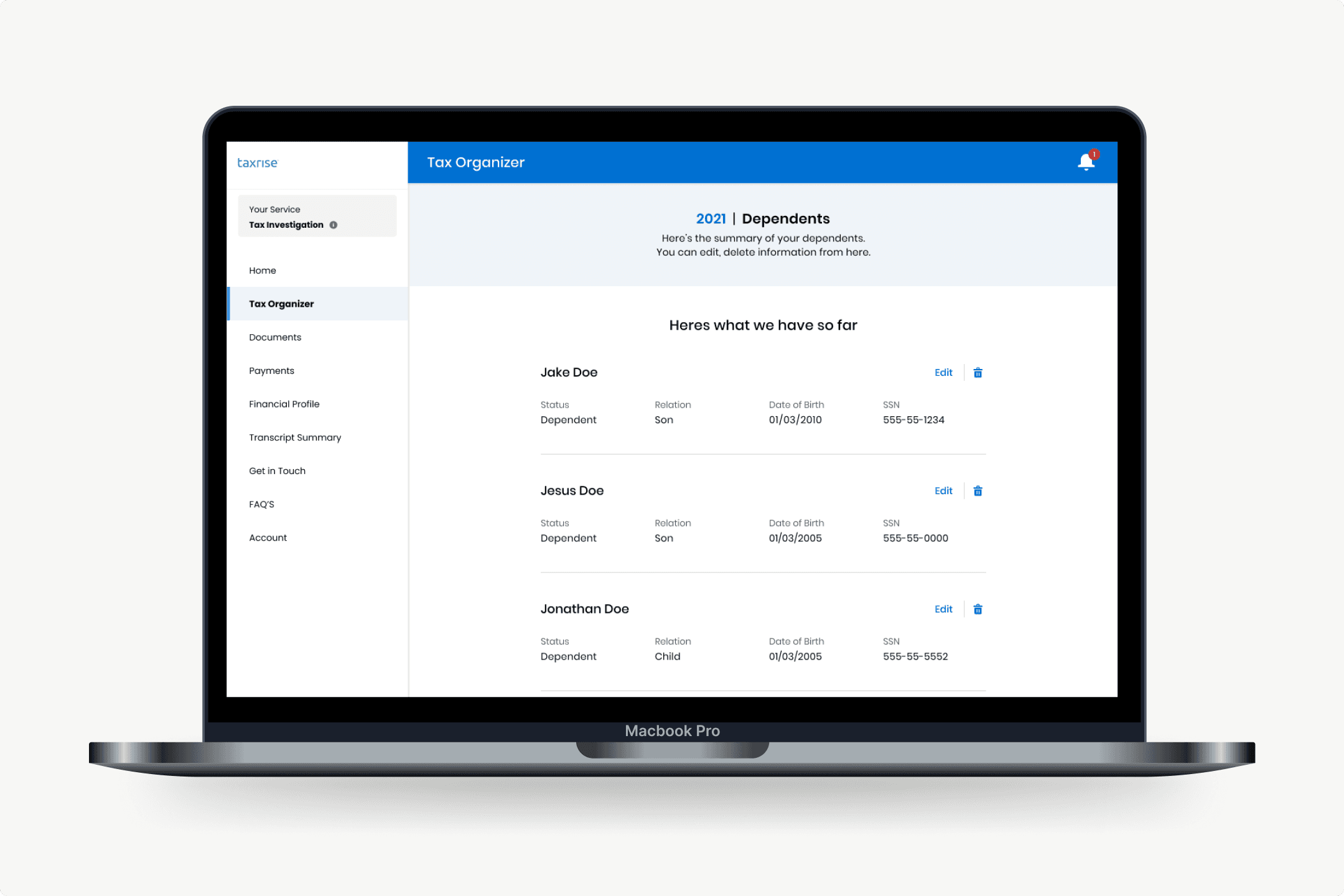
The self-service Tax Organizer intake flow, live in the client portal
TaxRise
Replacing a 15-day manual process with a self-service form
Over 40% of TaxRise clients had multiple unfiled tax years. Collecting what was needed took 15 to 20 days per client: phone calls, faxes, and unsorted document uploads. I designed a structured self-service intake tool to replace all of it.
MY ROLE
Lead designer, discovery through handoff
I drove the design from discovery through final handoff. I worked directly with the CEO, the lead tax professional, a Salesforce consultant, and the lead developer. The project had been flagged as a priority by leadership.
THE PROBLEM
A manual process at scale
Before TaxRise could resolve a client's tax debt, every unfiled year had to be filed. The average affected client had 4 to 5 unfiled years. To gather the information needed, clients mailed documents, sent faxes, dropped things off in person, or went back and forth with a case manager over the phone, often without the documents they actually needed.
The intake process took 15 to 20 days per client. Reps were stretched across high case volumes. Scanned documents came in illegible or incomplete. There was no way for clients to see what they'd submitted, what was missing, or where things stood. Resolution couldn't start until intake was done, which meant the entire business pipeline was gated behind this bottleneck.
Resolution could not begin until every unfiled year was filed. So this one intake step gated the entire business, not a single team's workload.
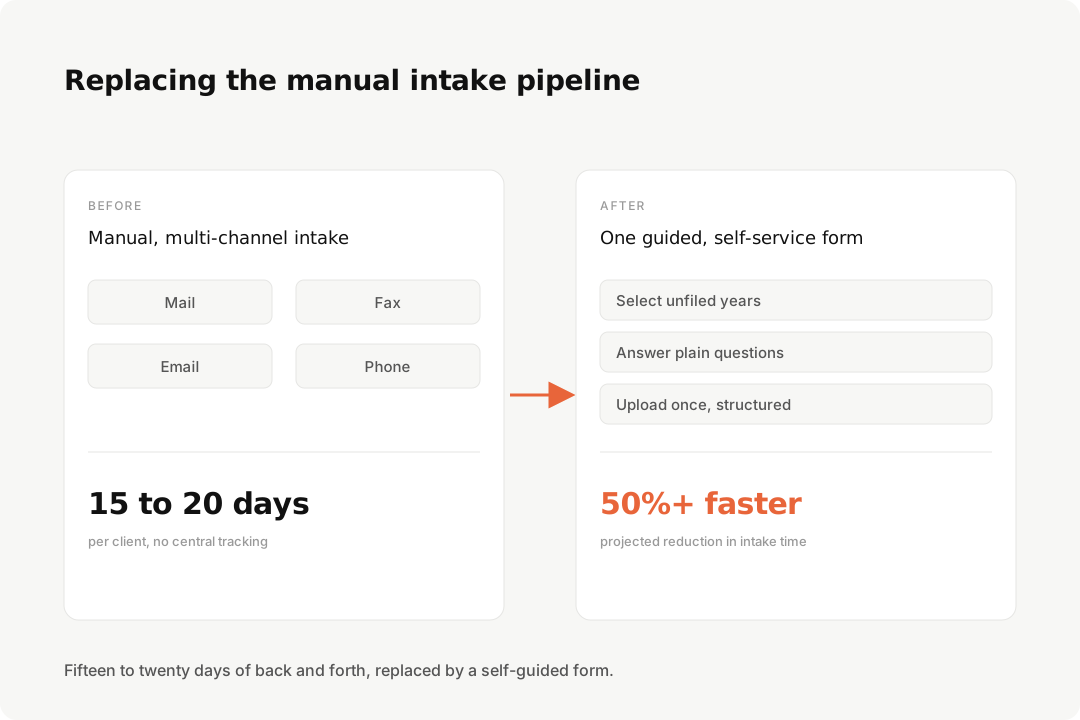
Manual multi-channel intake, replaced by a self-service form
"Our goal is to digitize an industry stuck in history."
Sam A., Founder & CEO
DISCOVERY
Learning the domain first
I started by studying how TurboTax, H&R Block, and FreeTaxUSA handled single-year filing. Not because we were building that, but to understand how the best products in the space structured the question flow. None of them dealt with multi-year filing, which was the core problem we were solving.
Time with in-house CPAs and case managers filled in what the competitive analysis couldn't. They'd done this intake hundreds of times and knew exactly which questions tripped clients up, what data was actually needed per year, and where the existing process fell apart.
The biggest design constraint coming out of discovery: the average TaxRise client had no tax literacy. They didn't know what a W-2 was, couldn't tell a 1098 from a 1099, and didn't understand the difference between state and federal filing. Everything had to be designed around that baseline.
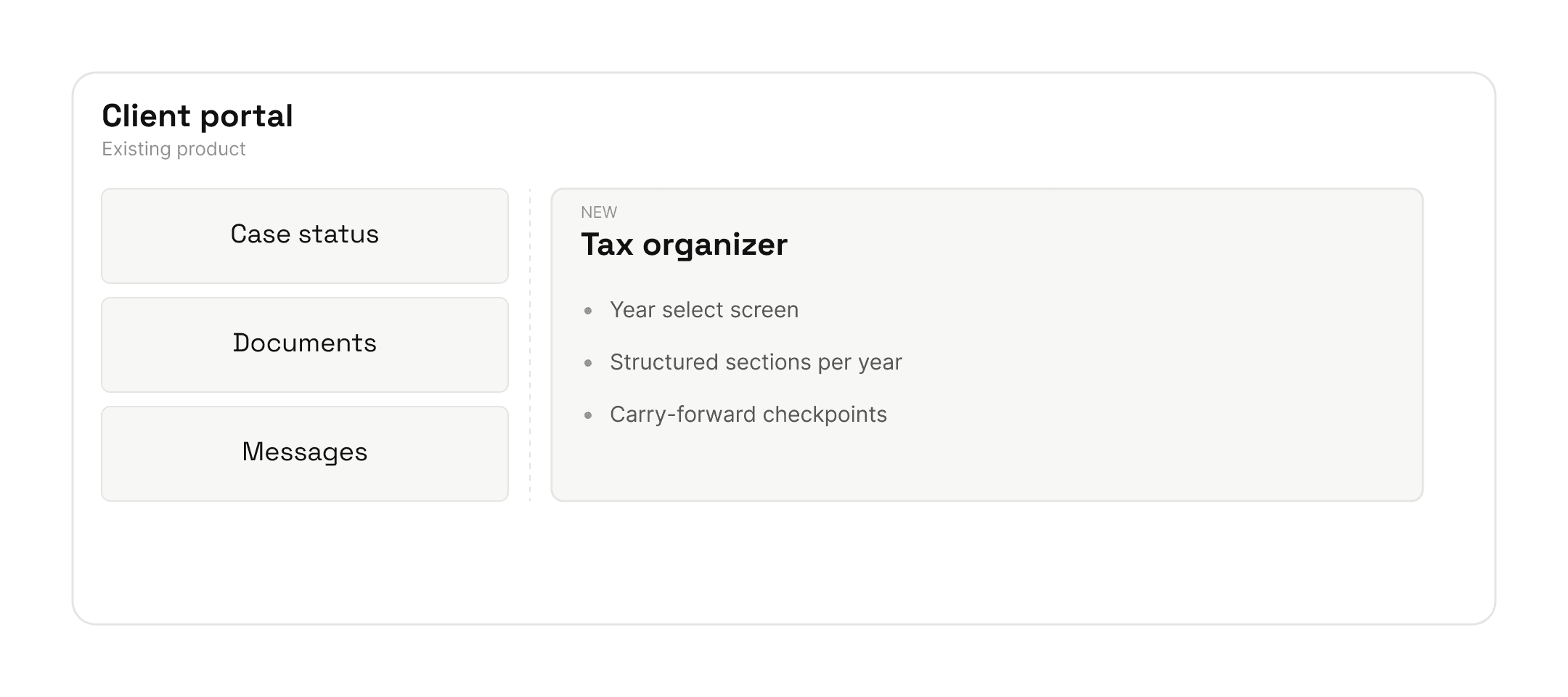
Tax Organizer placement within the client portal
KEY DECISION: CARRY-FORWARD
Solving for four years of the same questions
The average client had four to five unfiled years, and some had ten. Most of what the IRS needs for one year is identical to the year before it. The design question was how to collect ten years of tax data without asking someone with no tax knowledge to answer the same forty questions ten times.
Year by year
Explored, rejected
Carry-forward
Chosen
Complete a full set of questions for each unfiled year, one year at a time
Complete the most recent year in full, then confirm at each section which other years match
Every question, every year. Roughly the same answers repeated four to ten times
The full set once, then a yes or no per section for the remaining years
Clients abandon partway through, or start guessing to get to the end
Requires clear checkpoints, or a client can carry forward something that actually changed
Simple to build and simple to understand, but it treated a client's time as free
Cut total inputs sharply while still capturing the years that genuinely differ
Year by year
Explored, rejected
Carry-forward
Chosen
I started with the most recent year rather than the oldest for two reasons. Recall is better for the year a client just lived through, so the first and most detailed pass is also the most accurate one. And the most recent year is the likeliest to resemble the years next to it, which means the carry-forward is doing the most work when it's most reliable.
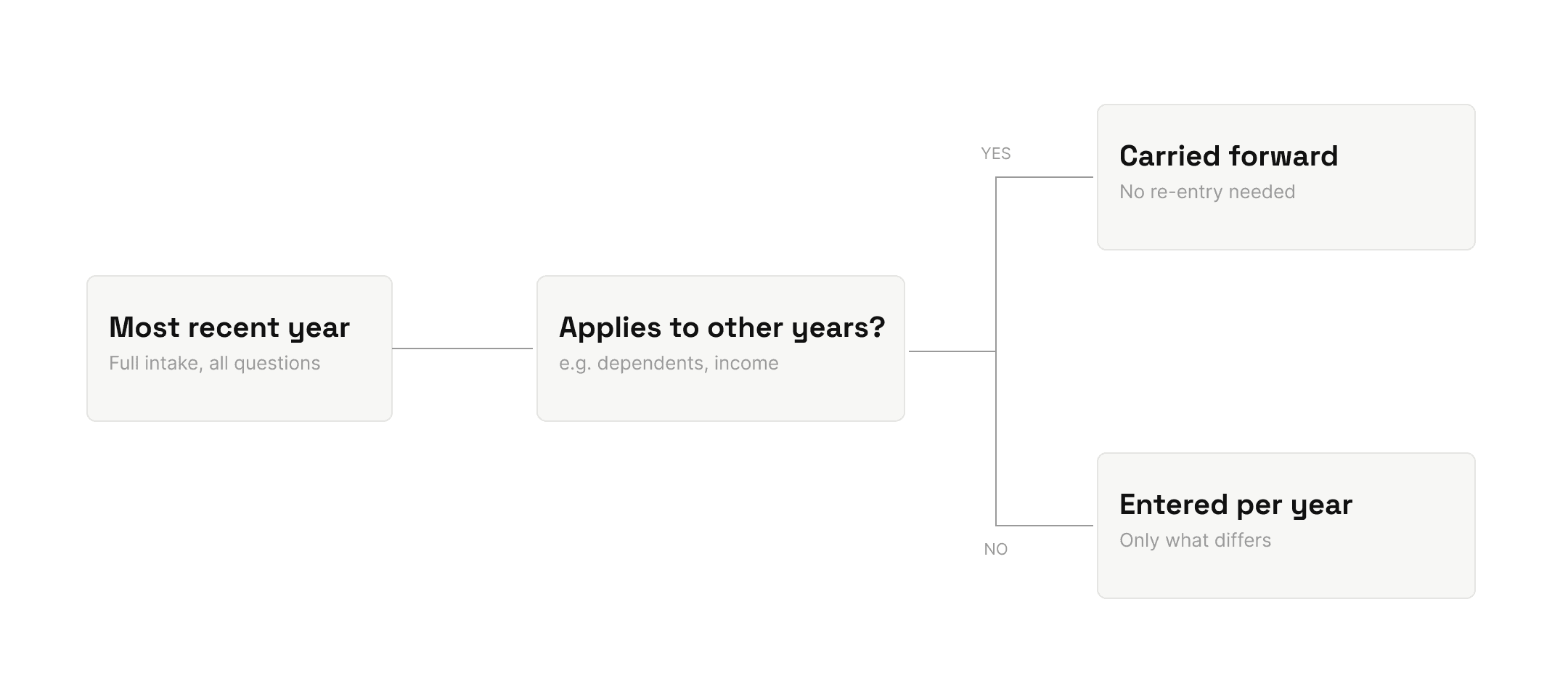
Carry-forward checkpoint applied at the end of each section
KEY DECISION: PLAIN LANGUAGE
Plain language over tax terminology
Instead of asking clients to identify document types, the form asked about situations.
The system matched their answers to the right tax forms in the background.
The year select screen showed every unfiled year with a clear status. Clients could see their full scope upfront and track progress as they moved through it. For a process that could easily feel like it had no end, that visibility mattered.
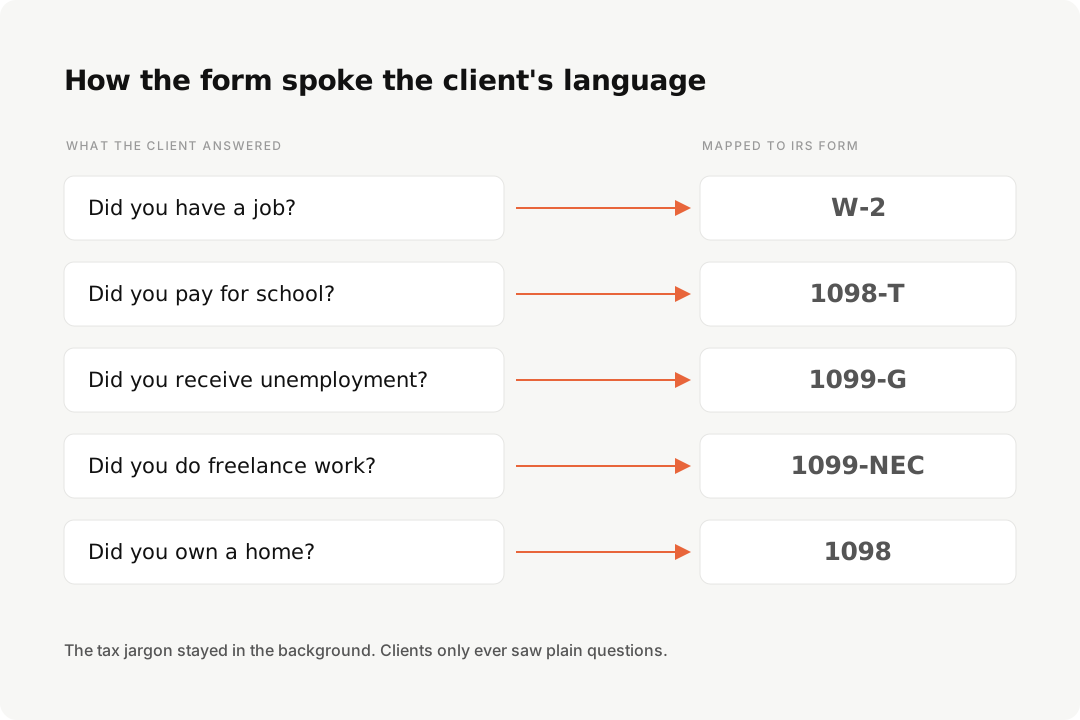
Plain-language questions mapped to IRS forms behind the scenes
CONSTRAINTS
Designing for handoff from the start
Developer turnover was a constant on this project. Designs had to be documented clearly enough that someone new could pick them up cold. The tax team kept refining what data they actually needed, which meant requirements shifted regularly. The form also had to handle:
All without becoming a system too complex for a non-technical client to navigate.
IMPACT
Handed off, not yet shipped
The projected impact was based on what the workflow changes would eliminate:
I completed design and handoff over roughly 2 months and left TaxRise before the Tax Organizer was built and deployed.
The carry-forward system was the part I was most confident in. It's the kind of decision that doesn't show up in a static screen. For a client with five unfiled years, it can be the difference between completing the process and giving up.
REFLECTION
What I learned
I validated with experts when the whole design was built for novices
Carry-forward came out of the domain, not the interface
Designing for a build I wouldn't be there for
More Work